Original post at Medium - Product Coalition - Digital Product Levels and Layers: Two Component Frameworks Product Managers Need To Know
When looking at digital products, one can quickly realize that many strategies are applicable and can be articulated. Making the right decision and implementing the right strategies can become quite overwhelming for your organization.
In this article, I’d like to discuss ways to think about products — and the surrounding strategies — in terms of layers.
Frameworks are intended to help organize your thoughts when looking at types of products, or different parts of a larger product. Looking at all the components and the way they interact with one another will help us better formulate strategies.
We will walk you through two ways to look at digital products and structure our thinking. In my view, both frameworks are complementary and can be used on their own.
These frameworks are intended to be generic and should apply to most industries. Of course, frameworks are also meant to be adapted to your organization’s needs.
Levels of product value
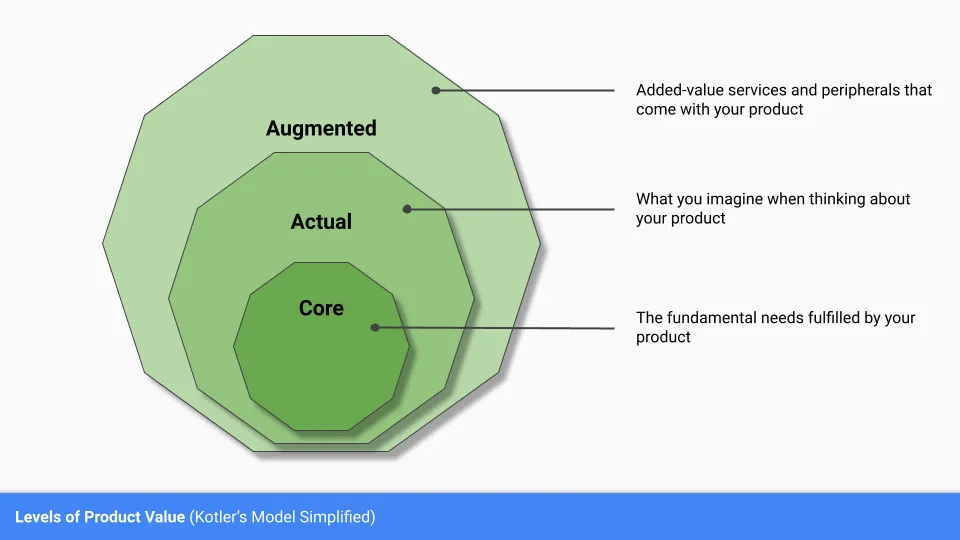
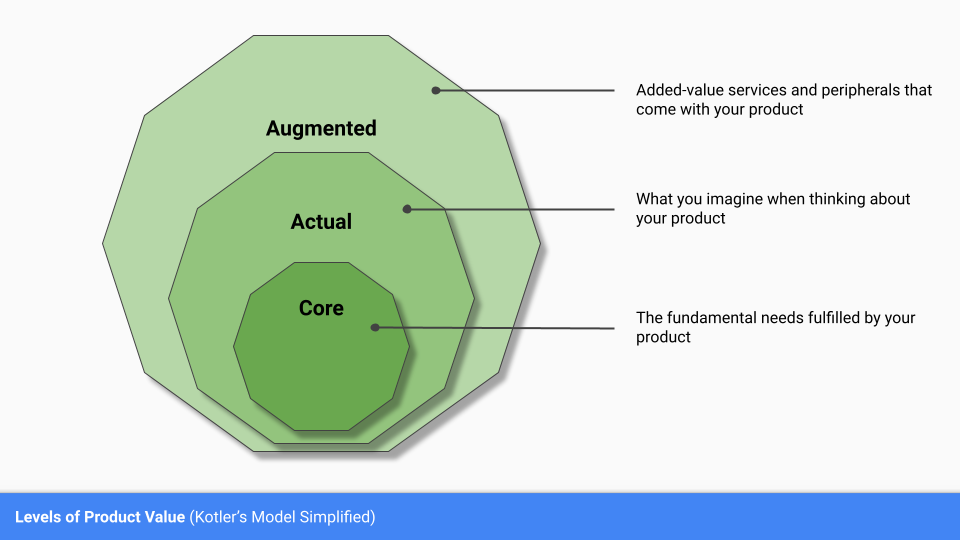
This first model is quite common when you are looking for product layers. It is a simplified view of Kotler’s Five Product Levels and looks at three main levels of product: the core product, the actual product, and the augmented product.
Core product
The concept of core product addresses the fundamental needs that a consumer is fulfilling by using your product. These are the psychological reasons for consumers to buy a product.
To think through that, Maslow’s Hierarchy of Needs gives a good view of fundamental human needs. By order of priority:
- Physiological—basics for human survival, e.g., air, food, drink, shelter
- Safety — order and security, e.g., police, medical care
- Love & belonging — emotional needs for interpersonal relationships, e.g., friendship, intimacy, trust
- Esteem — for yourself and from others, e.g., dignity, achievement, status, prestige
- Self-actualization — seeking personal growth and experiences, e.g., achieving your potential, learning, self-development, creative activities
Consumers will prioritize the acquisition and usage of products following that order.
When looking at your product, it is critical to understand the fundamental needs that it is providing for. A lot can be derived from addressing and targeting the psychological reason of a buyer (e.g., marketing, sales plan, pricing). This is the core of your product.
Actual product
The actual product is what people imagine when thinking of your product. This is typically what’s advertised by your company. Think of a car, a fridge, or a phone...
The actual product is made of the features and functionalities that your consumer is expecting when buying your product. And typically it is not differentiated in a consumer’s mind. Samsung and Apple both fulfill the function of being a smartphone.
Augmented product
Lastly, the augmented product refers to all the “peripherals” that can come with your actual product. Think of the mouse, webcam, or external hard drive that comes with a computer. More generically it includes any value-added services that are in addition to your actual product.
Extended warranty, color customization, or additional packages with your new car. More often than not, the augmented product is what is used to differentiate your product from the competition.
Now, when looking at your product, it is important to understand how the augmented product is in line with your core product. You cannot sell a core product targeting safety and have an augmented product that provides a service doing the opposite.
Core, augmented, and actual products need to work symbiotically.
Layers of digital products
With this second framework, I want to take an approach that is similar to Kotler’s and build on it. This model will be articulated in terms of digital product layers.
When evaluating a digital product, we can break it down into three basic layers: the infrastructure layer, the application layer, and the service layer. Furthermore, I believe that a digital product needs to serve one or multiple use cases. These use cases are built on top of the infrastructure layer and interact with the application and service layers.

Infrastructure layer
The infrastructure layer is the baseline on which your product is built. I have found that this layer tends to be forgotten by product organizations.
However, the infrastructure layer is critical to delivering a reliable digital product and consumer experience.
You can think of the infrastructure layer as the components of your product that deliver performance, scalability, reliability, and quality. These are key components that your customers will be expecting.
Application layer
Similarly to the actual product we discussed in the previous framework, the application layer is usually what a user thinks about when picturing your digital product.
Vice-versa, the application layer is what your organization will sell first to your customers. It is the set of features and functionalities that make your product what it is. These capabilities are then built into a web application, an iOS or an Android application…
The application layer is what your users will be interacting with. It comes with a user experience (UX) which typically takes life through a user interface (UI).
Service layer
Again, we can draw a direct parallel between Kotler’s augmented product and this service layer.
The service layer is built on top of — or sold in addition to — your actual product. These value-added capabilities are provided as a supplement to your application layer.
In the digital world, the service layer is what multiples the value of your application itself by targeting a set of more specific, though less fundamental, requirements or customer asks.
People want to buy your application first but are also expecting to get certain levels of service. Things like service level agreements (SLAs)! Customer support with agreed-upon response time, the ability to integrate your application through a single-sign-on (SSO), or additional dedicated storage — all three are examples of services that a company might offer.
Lastly, in the way I think about products, there is a fourth layer that sits parallel to some of the layers we just discussed. This layer answers the question of why are we even building a product. The application and service layers are designed to answer this why; the underlying customer requirements.
To be the most relevant to any buyer, these requirements should be articulated around use cases.
Use case layers
This layer is a bit different, though. It addresses what your customers do. More specifically, what they try to accomplish by buying your product.
A use case is a scenario for your digital product. It explains a situation where your product can be useful. Use cases themselves can be broken down into layers, but this time in varying degrees of specificity.
I find it helpful to think of these layers as segments of an industry. I will use an example to walk you through this part.
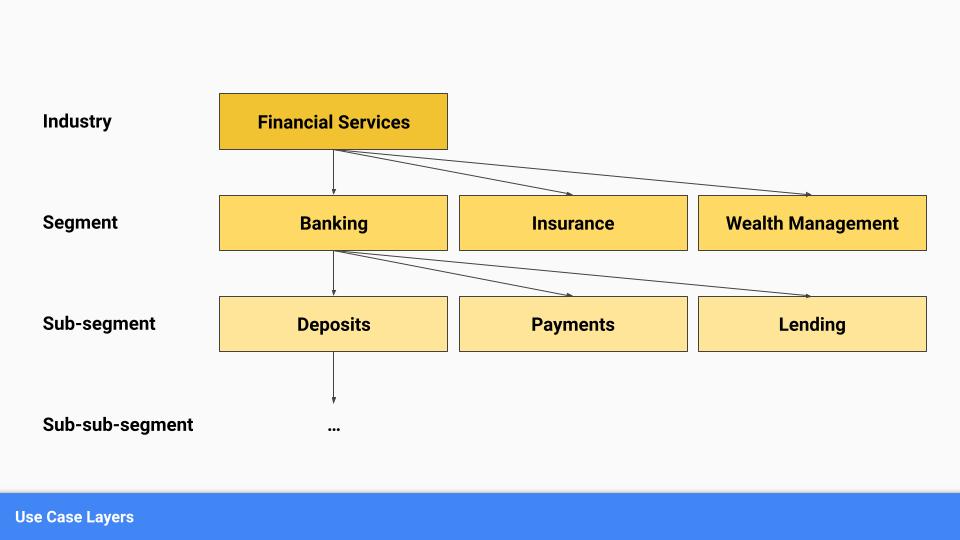
- At the top is the industry layer. What broad set of clients does your company serve? Think financial services, healthcare, automotive, travel… These are also called verticals or domains.
- An industry can then be broken down into segments. In a given industry, what set of clients should your company target? This time think banking, insurance, wealth management…
- A segment can then be further broken down into sub-segments. If we pick on banking, what specific needs are you going after? You can think of deposits, payments, lending…
This can go on as far as you want to take it. The further you go down into additional layers, the more targeted the use cases will become. This approach will allow your organization to target specific niches.
Once you’ve identified the right use cases for your product, your company needs to articulate the pain points that your application and services are solving. These can be articulated in the form of challenges that your company will target.
Formalizing these use cases and corresponding challenges is what will constitute a critical part of your product strategy. It ties everything together in a coherent value proposition for your customers, answering their specific requirements.
In conclusion, we looked at two frameworks that can help your organization as you go through your product strategy development process. The first broke down a product into three levels: core, actual, and augmented. The second look at a digital product in the form of layers: infrastructure, application, and service, and the way these layers should address a customer use case.
If you are interested to go further into the subject of strategy, I am discussing a framework for product strategy in more detail in a separate article.