Original post at Mediuam - Bootcamp - A Process for Product Management
When we talk about product management, we usually look at frameworks and methodologies to help us build better products. This is done either through a more robust product strategy or by taking a different look at key components that constitute digital products.
Today, I want to talk about a more fundamental aspect of product management. An aspect that’s essential for companies looking for scale — especially as your product organization grows. I want to talk about the processes that exist around good product management.
In this article, I want to discuss how to establish a product management process that will work at scale. This will help organize your teams along the same cycles — and thus drive efficiencies.
The Key Phases
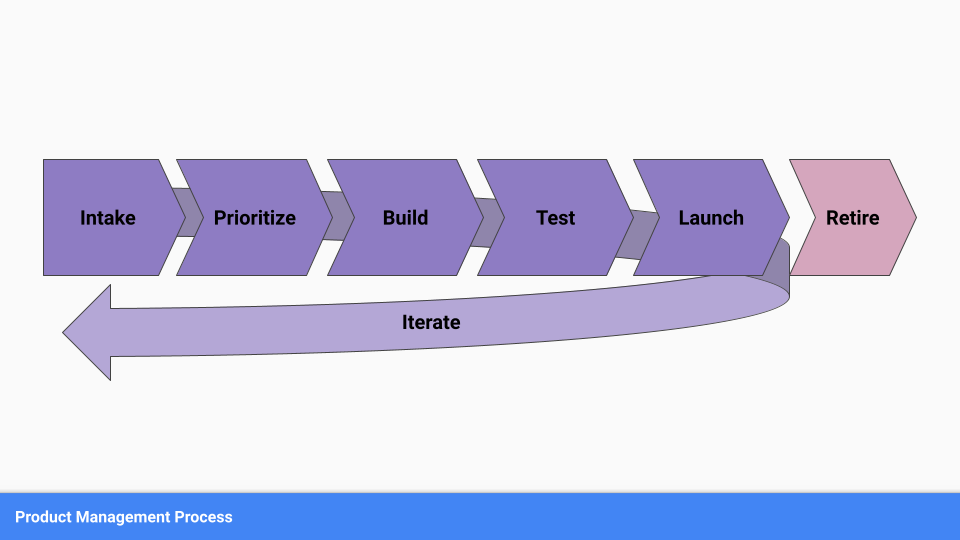
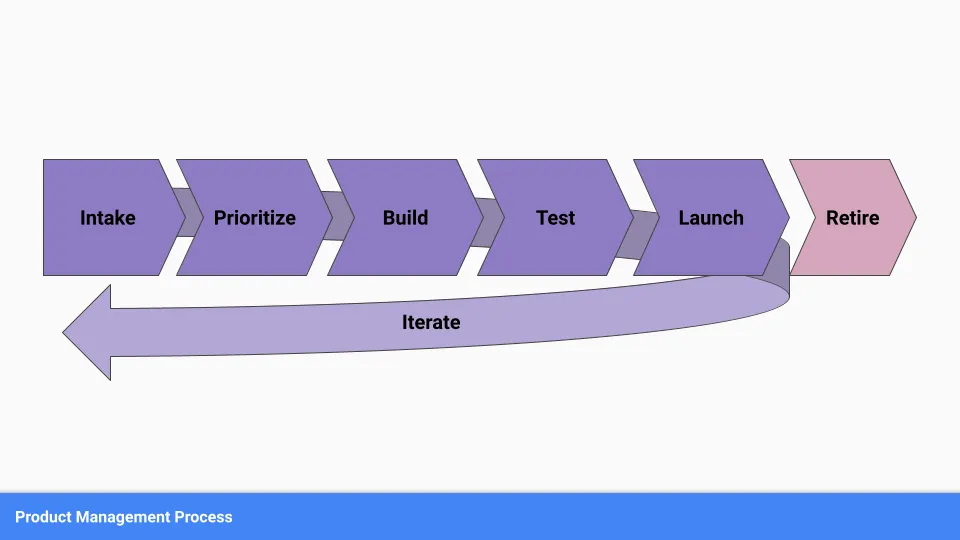
I will walk you through a model that I found helpful to structure product management processes. This model breaks down the process into a few key phases which take us through the lifecycle of a product.
It’s important to note that your team members will work on various ideas and initiatives at the same that are in different phases of this product management process.
The key phases of this process are:
- Intake
- Prioritize
- Build
- Test
- Launch
- Iterate
- Retire
Intake
The intake phase is the first step in the product lifecycle and the first phase in our product management process. This is the phase where ideas get in, and things get started.
One of the key goals is to define the problem statement. It describes the business issue or opportunity that’s been identified, but it should not articulate a solution at this stage.
It’s during this step of the process that your product team should also conduct the first level of triage. By triage, I mean sorting out the ideas at a high level. Keeping in mind your product strategy, your team should be able to sort the ideas into three broad categories: will do, parking lot, and won’t do.
- Will do: ideas that are aligned with the strategy and will likely be executed in the next 12 months (note: 12 months is an example)
- Parking lot: ideas that are aligned with the strategy but won’t likely be executed in the next 12 months
- Won’t do: ideas that are not aligned with the strategy
You will want your product team to think through target personas and segments in this phase as well. It is important to keep in mind the customer early on.
At the same time, it’s good to identify a potential Minimal Viable Product (MVP)— not technically, but from a business perspective. If you were to solve the business problem identified with this idea, what would be a good minimal set of capabilities that you could go to market with?
Here are some of the outcomes you should have after the intake phase:
- A problem statement is documented
- A high-level business case is created
- A potential MVP is identified
Prioritize
The prioritize phase is the next logical step in the product management process. Once an idea was refined, triaged, and a high-level business case was created, your team should prioritize and plan for the work related to this idea.
Now, prioritization is one of the most challenging steps in product management and tends to be a complex task for an organization/product manager to accomplish. Lots of factors come into play and influence the decision-making process. Prioritization methodologies and frameworks can become handy (e.g., RICE, MoSCoW, value vs. effort). The deliverable you are looking for is a ranked list of ideas. This prioritized list is what composes your team's backlog and roadmap.
So, once the ideas have been prioritized, your product managers should spend some time creating a plan for the highest-ranked ideas. These plans will be the inputs of the next key phase of our product management process. Think of these plans as epics, product definition documents, etc. Now is also a good time to start involving your technical teams.
It’s at this stage of the product management process that an idea will become what I call an initiative. An initiative differs from an idea in the sense that an initiative has been prioritized, and a plan is behind it.
Here are some of the outcomes you should have after the prioritize phase:
- Ideas are prioritized
- Initiates are defined on your roadmap
- The business plan is finalized
Build
The build phase is when things become real!
As part of this phase, your product and technical teams will work iteratively to refine requirements on a given initiative, engineer a solution, and develop that solution. This is typically the phase that takes most of your team's capacity.
This phase should also involve significant documentation activities: designs, engineering solutions, acceptance criteria, test cases…
At the end of this phase, here are some of the key outcomes:
- The MVP/feature is built
- The documentation is updated
Test
The test phase is an optional although highly recommended phase of the product management process. It is optional in the sense that not all initiatives need to go through a rigorous testing period. Your team has to define criteria that specify the initiatives requiring a test period.
The test phase is intended for trial and error. I mean that this phase gives your organization a chance to test-run a new product, feature, or capability before making it generally available. This usually takes the form of a beta test. A beta test consists of identifying a subset or sample of your target personas to try your new capability out and to provide feedback.
During this phase, your team also has the opportunity to make adjustments which usually originate from the feedback beta testers provide. Therefore, before launching the beta test of a new product, your team should align on what kind of feedback they are looking for, and how it should be captured. It is important to communicate that information to your beta testers.
Additionally, your team should also define what success looks like. As I said before, the test phase is the last stage before something goes to general availability. Your team needs to define clear and measurable success criteria that will allow making a go/no-go decision at the end of the period.
In parallel, your product team should also work closely with your marketing and sales team to plan the launch itself. This work should result in a go-to-market plan that includes sales and marketing efforts (e.g., press releases, channels, campaigns, timelines).
Here are some of the outcomes you should have after the test phase:
- The MVP is tested and finalized
- Feedback is captured and addressed
- A go-to-market plan is created
- A go/no-go decision is made on the launch
Launch
Congratulations, you are ready to make your newest initiative generally available!
The launch phase consists in executing the go-to-market plan you’ve previously defined. This phase also includes the commercialization of your product.
But, before the launch actually happens, your product team should make sure that stakeholders have properly been informed and trained. Especially if you are launching a new product or a critical feature. I’m talking about sales being informed, marketing being ready, and customer service being trained.
Once the launch happened, your team can celebrate and breathe a bit. But the work is not over!
After the product, feature, or new capability is launched, your teams should keep an eye on it. Your organization should measure the performance of the product:
- How is the market responding?
- Are customers happy?
- How is the product performing compared to the business case?
So, your product managers should have a plan for capturing this information. After all, the lifecycle of a product is not done with the launch: more iterations are coming.
Some of the outcomes of the launch phase:
- The product is made generally available
- A process to capture customer feedback is in place
- The performance of the product is monitored
Iterate
As mentioned previously, the iterate phase is the stage of a product lifecycle meant for gathering feedback and continuous improvements.
A product is never done — it can always be improved upon. For instance, your team should iterate on the work items, plan the upcoming release…
This is an ongoing phase. Here are some of the activities that your team should be tracking:
- Next releases are being planned
- Feedback is being captured, reviewed, and addressed
- Results are measured
Retire
The retire phase is the terminal phase of our product management process.
In some scenarios, products have a finite life expectancy: new versions are released and old ones are sunsetted. In your organization, this might not apply to an entire product offering, but it’s likely the case for a version or a feature of this product.
This is the de-commercialization of a part of a product and a clear communication plan needs to be created, especially if you still have customers using this part.
Conclusion
In this article, I talked about a more fundamental aspect of product management as companies look to scale: establishing a clear process for product management.
As with all my articles, I’m sharing an opinion — a framework — that you might find helpful as you go through the same thoughts internally. In the case of this process, feel free to tailor it to your organization's needs and ways of working.
For instance, I have not addressed or recommended specific timeframes or meetings to help your team get organized around all these phases. It is up to your team members to figure out what cadences work the best for them (P.S. I might share some thoughts on this topic in the future).
Ideas and initiatives will exist in various phases of this product management process. Getting a process documented and instituted across your organization will help you scale and drive efficiencies across your teams.