Original post at Medium - A Framework for Product Strategy
I’ve been doing a lot of thinking recently on product strategy and how to best articulate one. I found it very helpful to use frameworks to guide our thought process.
If you feel that your teams are not working in unison, or that there is not a clear path to winning, it’s likely that your product strategy is not articulated or communicated well enough (if you have one at all!).
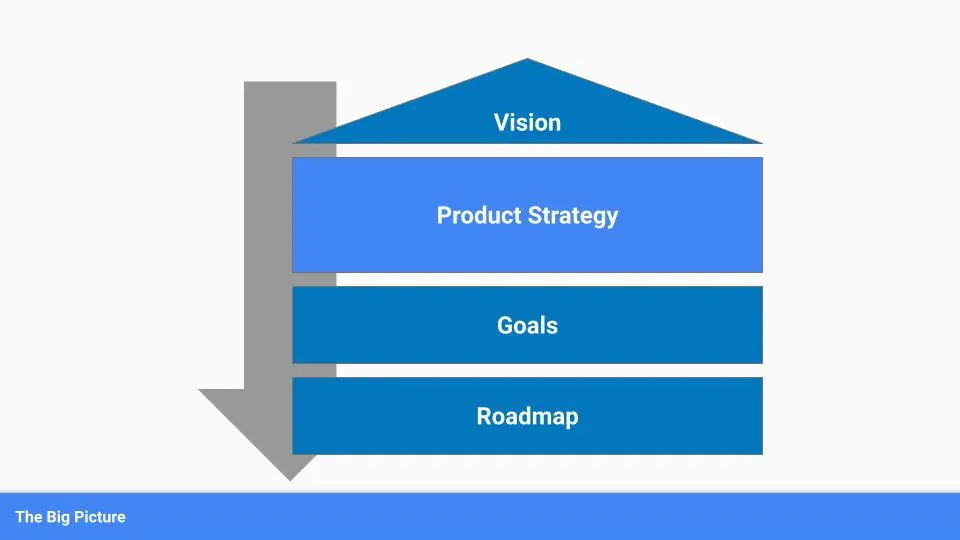
Before jumping into the specifics of a product strategy, it is essential to understand the role of this strategy in the bigger picture — the pieces that make your organization move forward.
The Big Picture
In my view, a product strategy is one critical element of the bigger picture. It’s a piece of the puzzle that makes a product and a business successful. It’s the centerpiece that ties everything together.
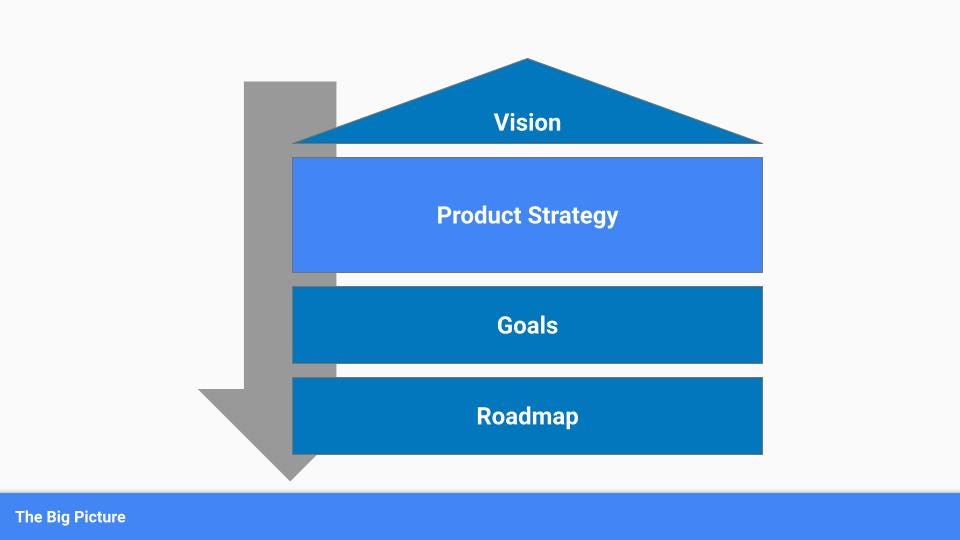
To keep it simple, we will talk about four main components:
- Vision
- Product Strategy
- Goals
- Roadmap
Vision
What’s the mission your company is going after? Where do you see your company/product in 3–5 years? What would the headlines be?
The vision seats at the top (or at the bottom if you want to think about it in terms of a pyramid) and defines everything that your organization will do in the long term. It articulates a view of the world in which your organization had a significant impact. It is a powerful motivator for your organization — the why everyone rallies with.
A vision should be ambitious while still feeling realistic.
Without a clear vision, your product strategy might feel inconsistent or disparate.
Product Strategy
This is our main topic. The product strategy is the component that ties everything together. It takes the vision and brings it to life.
We will talk about product strategy in detail in the second part of this article.
Goals
You can think of this component as goals, objectives and key results, targets, milestones, or whatever framework for goal tracking works best for your organization.
These are the metrics that can be derived from the product strategy and will help your product team prioritize their respective strategies and roadmaps.
Your entire organization should be aligned around the same goals. This drives the focus needed for success!
Roadmap
The roadmap is the temporal translation of your product strategy. It provides a prioritized view of the key deliverables your team will be working on over the next few quarters.
A roadmap is set in time and usually comes with identifiable milestones that your organization is looking to achieve. The steps that your team needs to take, the capabilities that need to be developed, to execute your product strategy.
If your team struggles with prioritization or defining a clear roadmap, it’s very likely that your product strategy or vision is not well articulated.
Framework for Product Strategy
Now that we’ve briefly talked about where in the big picture your product strategy seats, let’s look at a framework that can help you think through a strategy.

In my view, a product strategy should articulate three key parts: a set of challenges, a decided approach, and some resulting actions.
Challenges
The goal of the first part is to articulate an analysis of the problems/situations you are trying to solve. It can be oriented for your customers, or internal to your organization.
The analysis should include a comprehensive explanation of what the problems are, and why they are worth solving. Try to simplify the complexity that is behind the situation and identify the aspects that are critical.
Here are a few questions that can help:
- What are the problems we are trying to solve?
- What challenges (internal or external) are we trying to overcome?
- What is the opportunity and why do we think we should go after it?
Decided Approach
The second part of a product strategy is to articulate the approach you want to take. This can be a set of policies that your company will put in place for dealing with the challenge. It’s the overall approach chosen to cope with the analysis conducted in the first part.
The approach itself can take various forms: the bets your organization wants to place, the solutions you‘ve found, or basically the ways you will solve the challenges you identified.
Again, here are some questions that can guide the thought process:
- What is the value proposition we want to bring to our customers?
- What segment are we targeting first?
- What is our differentiator? Our competitive advantage?
Actions
The third and last part is to identify a set of actions that results from the approach you decided on. These actions should be the outcomes of the second part.
These actions need to be coordinated with one another. They too can be quite varied: products or features you need to put on your roadmap, new capabilities you need to acquire through partnership, or new marketing campaigns you want to launch. Whatever is coherent with the challenges you identified and the approach you opted to take.
Lastly, some more questions that can help:
- What capabilities do we need to build or acquire?
- What is the identified solution? The key deliverables?
- What should we add to our roadmap?
Put it all together…
… and iterate!
Strategy is not a one-and-done activity—the world changes. Markets evolve. New competitors appear. Customer behaviors and expectations change.
You’d be surprised how fast strategies can sometimes become obsolete with one unexpected event. Make it a muscle. Build a habit with your teams to review, evaluate, and course-correct your strategies. Quarterly is a good start. More frequently if you are in a recent or unstable industry.
I’m leaving you with some references if you want to read more on this topic:
- Good Strategy Bad Strategy: The Difference and Why It Matters by Richard P. Rumelt (Goodreads)
- The Product Book (Product School)
- Thinking, Fast and Slow by Daniel Kahneman (Goodreads)